

Fixed IP SIM Card for IoT Devices: When You Need One (and When You Don’t)
Quick answer
A fixed IP SIM card, also commonly called a static IP SIM, gives a cellular device an IP address that stays the same each time it connects to the mobile network.
For many IoT and M2M deployments, this makes remote devices easier to identify, access and manage.
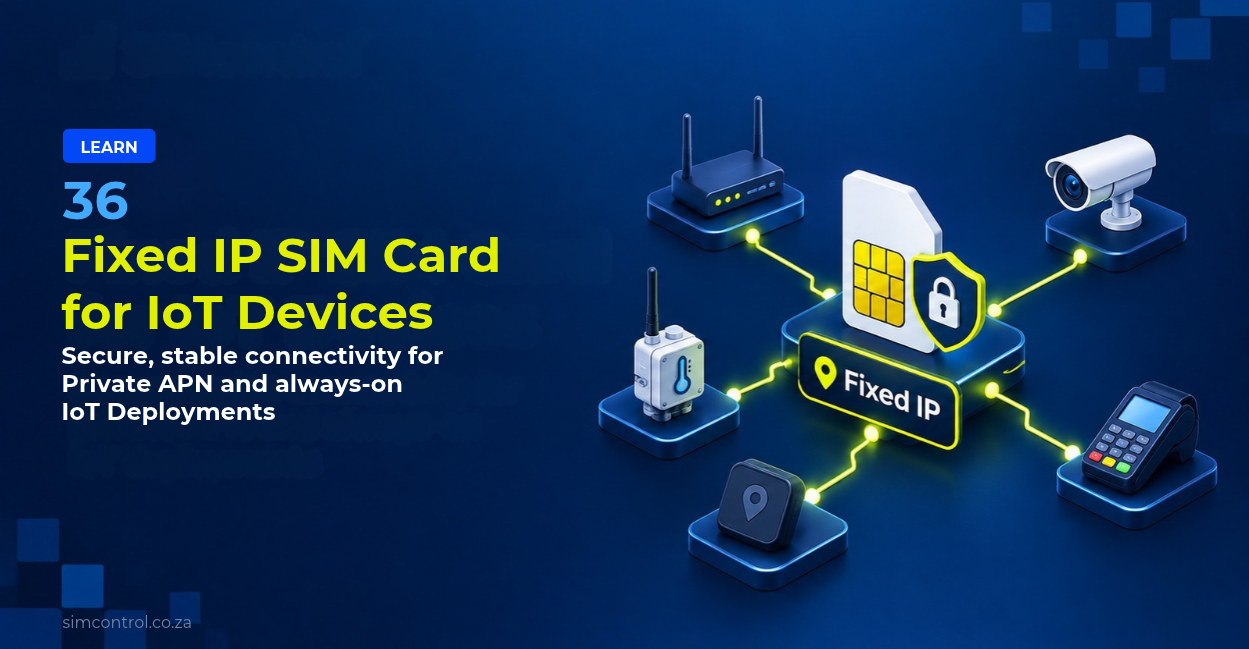
Fixed IP SIMs are particularly useful for devices such as:
- IoT gateways
- industrial controllers
- routers
- CCTV and security devices
- smart infrastructure
- remote telemetry equipment
- tracking and telematics hardware
- other devices that need predictable two-way communication
However, not every IoT device needs a fixed IP.
If a device simply sends data outward to a cloud platform and never needs to be reached remotely, a dynamic IP may be perfectly adequate.
The important question is therefore not simply “Do I need a fixed IP SIM?” but rather:
Does my device need a permanent network address so that authorised systems can reliably reach it?
What is a fixed IP SIM card?
Most standard mobile SIMs are allocated a dynamic IP address.
This means the IP address can change when the device disconnects, reconnects or starts a new mobile data session.
A fixed IP SIM works differently.
The SIM is allocated an IP address that remains associated with that connection, giving the device a predictable network identity.
You may see several terms used to describe this:
- Fixed IP SIM
- Static IP SIM
- Fixed IP SIM card
- Static SIM IP
- Fixed IP IoT SIM
In most business connectivity discussions, fixed IP and static IP are describing the same basic requirement: an IP address that remains consistent rather than changing dynamically.
Why do IoT devices use fixed IP SIMs?
IoT is not always one-way communication.
Some devices simply send information to a server. Others need engineers, applications or business systems to communicate back to them.
For example, a business may need to:
- log into a remote router
- troubleshoot a field gateway
- connect to an industrial controller
- monitor a CCTV installation
- send instructions to a remote device
- manage networking equipment
- connect two private network environments
- identify a specific device consistently
If the device’s IP address keeps changing, this becomes more difficult.
A fixed IP gives the device a predictable address within the network.
Dynamic IP vs fixed IP SIM
Dynamic IP SIM
With dynamic addressing, the network allocates an available IP address when the device connects.
This is suitable when:
- the device mainly initiates outbound connections
- remote inbound access is not required
- the application communicates through a cloud platform
- the IP address itself does not need to identify the device
For many basic IoT sensors, a dynamic IP may be sufficient.
Fixed IP SIM
With a fixed or static IP, the same address remains associated with the SIM or device connection.
This is useful when:
- a remote system needs predictable access to the device
- engineers need to manage equipment remotely
- devices form part of a structured private network
- firewall or routing rules rely on known IP addresses
- two-way communication is required
- remote troubleshooting is business-critical
When do you need a fixed IP SIM?
1) Remote device access
This is one of the most common reasons businesses use static IP SIMs.
If a network engineer needs to log into a remote router, gateway or controller, knowing exactly where that device sits on the network makes remote support significantly easier.
Instead of trying to discover a changing IP address, the device remains available at a known private address.
This is particularly useful for devices installed:
- in vehicles
- at remote sites
- at customer premises
- in industrial environments
- in unmanned locations
2) IoT gateways and industrial equipment
Gateways and controllers often need more than simple outbound internet access.
They may need to communicate with:
- corporate systems
- monitoring platforms
- VPN environments
- cloud infrastructure
- other devices
- authorised engineering teams
A fixed IP makes these environments easier to structure and manage.
3) CCTV and security systems
Remote security infrastructure often needs predictable connectivity.
A fixed IP can make it easier for authorised systems to identify and communicate with cameras, gateways and other security equipment.
Where security is important, this is usually better implemented with a private static IP on a Managed Private APN rather than exposing the device directly to the public internet.
4) Remote troubleshooting
Sending a technician to a remote site is expensive.
If a device can be securely reached over the mobile network, technical teams may be able to:
- inspect its configuration
- troubleshoot connectivity
- change settings
- restart services
- diagnose problems
without physically visiting the site.
For large IoT estates, this can significantly simplify support.
5) Private network integration
A fixed IP is also useful where cellular devices form part of a private enterprise network.
For example, a business may connect remote SIM devices through a Managed Private APN into:
- its corporate network
- a VPN
- a cloud environment
- a data centre
- an internal application
Known private IP addresses make routing, firewalling and device identification easier to manage.
When you probably DON'T need a fixed IP SIM
Not every connected device needs one.
A fixed IP may be unnecessary when:
- the device only sends data to a cloud server
- all communication is initiated by the device
- the application already handles device identification
- no inbound connection to the device is required
- remote administration happens through the device vendor’s cloud platform
For example, a simple meter that wakes up, sends a small reading to a cloud platform and goes back to sleep may not gain much value from having a static IP.
The connectivity architecture should always match the use-case - dynamic IP SIMss don't need private APN networks and can happily operate on the public APN.
Private fixed IP vs public fixed IP
This is one of the most important distinctions when choosing a fixed IP SIM.
A fixed IP does not automatically need to be a public internet address. In fact, in very few cases would you want to expose a public IP address die to security considerations.
Private static IP
A private static IP gives the device a predictable address inside a private network environment.
The device is not directly exposed to the public internet.
Authorised users or systems can reach it through controlled network paths such as:
- Private APN routing
- VPNs
- IPsec tunnels
- corporate network connections
- Other SIMs on the same IP subnet
For most enterprise IoT deployments, this is generally the preferred architecture.
Public static IP
A public static IP makes the device addressable from the public internet, subject to the relevant firewall and network configuration.
This may be required in certain specialised use-cases.
However, exposing IoT hardware directly to the public internet can increase security risk and therefore requires appropriate local device firewalling and security controls.
Public static IPs should be only used because the architecture genuinely requires them, not simply because remote access is needed.
Why a private fixed IP with a Managed Private APN is often better
For enterprise IoT, remote access and security should be considered together.
SIMcontrol's Managed Private APN provides private static IP addresses as part of the connectivity environment.
This allows businesses to build a private cellular network where remote devices have predictable IP addresses without exposing those devices directly to the public internet.
The Managed Private APN can also provide:
- custom routing
- firewall policies
- traffic restrictions
- usage visibility
- pooled data
- SIM-level controls
- IMEI locking
- secure connections into corporate or cloud environments
The result is a more controlled environment than simply assigning a public IP to every device.
Fixed IP SIM example: remote router management
Consider a business with hundreds of cellular routers deployed at remote sites.
If each router has a dynamic address on a standard public mobile connection, directly managing those routers can become difficult.
With a Managed Private APN and private fixed IPs:
- Each router receives a known private IP address.
- The business creates a secure connection into the Private APN environment.
- Authorised engineers can identify each router by its assigned IP.
- Firewall rules determine who may reach those devices.
- The devices remain protected from direct public internet exposure.
This gives the business predictable remote access while retaining network-level security controls.
Fixed IP SIMs and CGNAT
Standard mobile connections frequently use network architectures that make direct inbound access difficult.
For normal smartphone use, this is rarely a problem because the device initiates connections outward.
For IoT equipment that needs to be reached remotely, it can become a major limitation.
Using a Managed Private APN with fixed private IP addressing provides businesses with a controlled alternative for reaching remote cellular devices without relying on direct public internet connectivity.
What to consider when choosing a fixed IP SIM provider
Before selecting a fixed or static IP SIM solution, ask:
1) Is the IP public or private?
Do not assume that “fixed IP” automatically means publicly reachable.
Understand exactly how the addressing works.
2) How will you access the device?
Will access happen through:
- a Private APN
- VPN
- IPsec tunnel
- corporate network
- public internet
3) What networks are available?
Coverage remains critical. SIMcontrol offers the following network options:
- Fixed IP SIM on Vodacom
- Fixed Ip SIM on MTN
- Fixed IP SIM on Telkom
The best IP architecture cannot compensate for poor mobile coverage at the SIMNcontrol offers all major networks on one Private APN.
4) Can the SIM estate be centrally managed?
Look for visibility into:
- SIM status
- data usage
- live sessions
- quotas
- alerts
- device assignments
5) Can traffic be restricted?
For enterprise IoT, the ability to restrict devices to approved destinations can improve security and help reduce unnecessary data usage.
6) Can SIMs be locked to approved devices?
IMEI locking can help prevent a SIM from being removed from its intended device and used elsewhere.
Fixed IP SIMs on SIMcontrol
SIMcontrol supports secure custom networking with fixed/static IP SIMs through our Managed Private APN offering.
Private static IPs are included as part of the Private APN environment, allowing businesses to combine predictable device addressing with:
- multi-network SIM management
- secure custom routing
- firewalling
- pooled data
- usage visibility
- data quota controls
- IMEI locking
- API integration
- enterprise technical support
This is particularly useful for businesses managing large fleets of remote IoT and M2M devices.
Common mistakes
- Assuming every IoT device needs a fixed IP
- Assuming “fixed IP” automatically means public IP
- Exposing devices directly to the internet when private access would work
- Choosing a static IP SIM without considering remote access architecture
- Ignoring mobile network coverage
- Treating IP addressing separately from SIM management and security
- Using public IPs without adequate firewall protection
- Using the "unrestricted" APN on Vodacom will not give you a fixed or static IP address on a SIM.
FAQ
What is a fixed IP SIM card?
A fixed IP SIM card is a cellular SIM that uses an IP address designed to remain consistent rather than changing every time the device reconnects.
Is a fixed IP SIM the same as a static IP SIM?
In most IoT and business connectivity discussions, yes. “Fixed IP SIM” and “static IP SIM” generally refer to a SIM with an IP address that remains consistent.
Why would an IoT device need a static IP?
A static IP is useful when a business needs predictable remote access to a device, structured private routing, two-way communication or easier remote troubleshooting.
Do all IoT devices need fixed IP SIM cards?
No. Devices that simply send data outward to a cloud platform may work perfectly well using dynamic IP addressing.
What is the difference between a public and private static IP SIM?
A public static IP can be reachable via the public internet depending on configuration. A private static IP exists within a private network environment and is normally reached through controlled routing such as a Private APN or VPN.
Is a private static IP more secure?
For many enterprise IoT use-cases, private addressing provides a stronger security model because the device does not need to be directly exposed to the public internet.
Can I remotely access an IoT device with a fixed IP SIM?
Yes, provided the connectivity architecture allows it. With a SIMcontrol Managed Private APN, private static IPs can be reached through an authorised secure network connection.
Does SIMcontrol offer fixed IP SIM cards?
Yes. SIMcontrol supports fixed/static private IP addressing through its Managed Private APN offering.
The bottom line
A fixed IP SIM is not something every IoT device needs.
But when your business needs to reliably identify, remotely access or securely communicate with a cellular device, a fixed IP can become an important part of the connectivity architecture.
For enterprise IoT deployments, the strongest approach is often not simply a public fixed IP SIM.
It is a private static IP combined with a Managed Private APN, giving the device a predictable address while keeping connectivity secure, controlled and centrally managed.
Related reading
- /learn/static-sim-ips-secure-apn-connectivity/
- /learn/private-apn-south-africa/
- /learn/mikrotik-ltap-mini-managed-apn/
- /learn/firewalling-on-mobile-sim-cards/
- /learn/sim-management-platform-south-africa/
- /learn/iot-sim-card-south-africa/
Speak to SIMcontrol about IoT SIMs, Private APN, pooled data, and SIM management for your business devices.
Request a call back today