

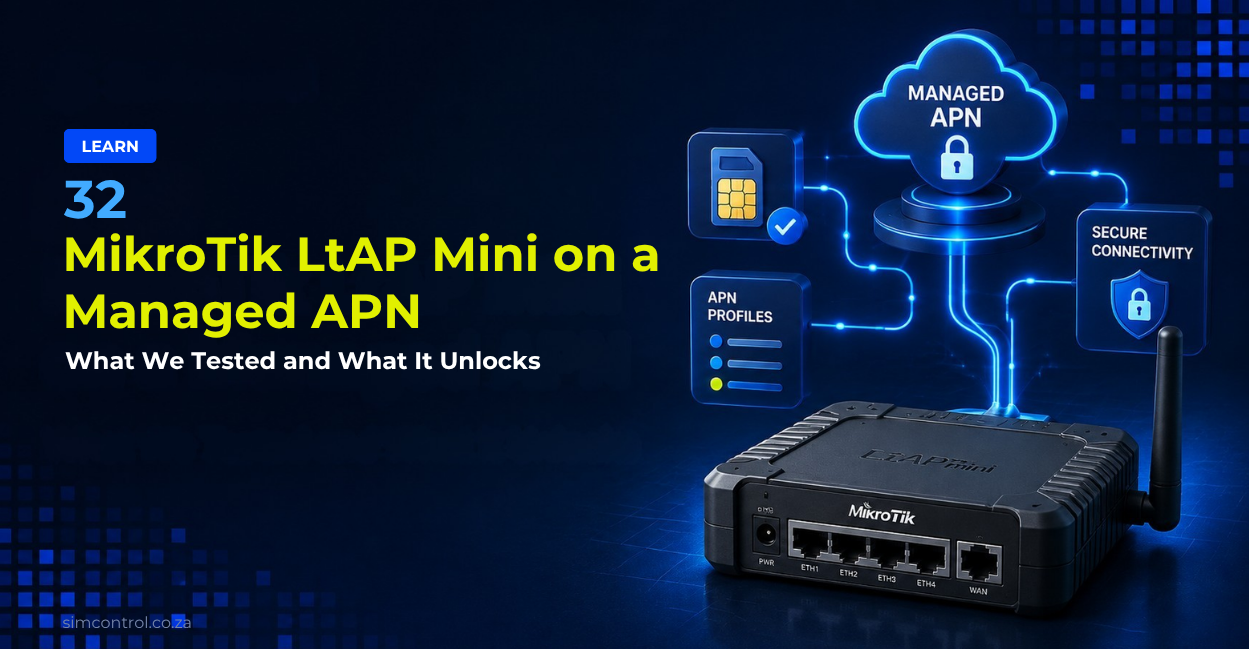
MikroTik LtAP Mini on a Managed APN: What We Tested and What It Unlocks
Quick answer
Here at SIMcontrol, we see a massive variety of cellular hardware pass through our networks every day, from simple tracking modems to heavy-duty industrial gateways.
Every now and then, we like to take a specific piece of equipment, put it on the bench, and explore what is possible when we pair its capabilities with our network infrastructure.
Recently, we’ve been looking closely at the MikroTik LtAP mini, specifically the RB912R-2nD-LTm&EC200A model.
Given its rugged form factor, built-in LTE, serial port and the depth of RouterOS v7, the LtAP mini is a favourite for fleet and remote IoT deployments.
We wanted to answer a specific question:
If a customer deploys a fleet of LtAP minis on a SIMcontrol Managed APN, what advanced integration and management possibilities can we unlock for them?
Here is what we discovered when we put the hardware to the test.
What is a Managed APN?
Before we dive into our tests, it helps to understand exactly what a Managed APN is.
Unlike a standard consumer SIM card that places your traffic onto the public internet behind carrier-controlled firewalls, a Managed APN places your SIMs onto a private, dedicated network layer.
With a Managed APN, you can get:
- static private IP addresses
- custom routing
- centralised control over where devices can and cannot send data
- network-level firewalling
- secure access to remote devices
- better visibility and governance across connected SIMs
This removes many of the limitations that typically come with standard cellular internet, especially for remote IoT, fleet and edge networking environments.
Why we tested the MikroTik LtAP mini
The MikroTik LtAP mini is built for cellular edge connectivity.
It is commonly used in:
- fleet and logistics deployments
- remote IoT sites
- mobile routers
- telemetry environments
- industrial and field connectivity
- vehicle-based Wi-Fi and device connectivity
The hardware is capable, but the real question is what becomes possible when that hardware is connected through a Managed APN rather than a standard mobile data SIM.
We tested the LtAP mini across several practical scenarios:
- true remote management
- out-of-band automation via SMS
- data abuse prevention
- private cloud routing
- dual-SIM roaming possibilities
Test 1: True remote management
The challenge
The most common complaint we hear about cellular edge devices is accessibility.
Standard mobile connections often sit behind Carrier-Grade NAT (CGNAT), making inbound connections to the router virtually impossible without messy workarounds.
Even with MikroTik’s own DDNS service, remote access can become more complex than it needs to be.
We wanted to see how clean we could make remote management using our core network.
The test
We provisioned an LtAP mini with a SIMcontrol Managed APN SIM, which assigns the device a secure, static private IP address on our network.
We configured the APN profile according to the official MikroTik LTE/5G documentation.
We then spun up a central IPsec tunnel bridging the LtAP mini’s network directly to a test management PC.
The result
The result was flawless, direct access.
As long as the LtAP mini’s SIM was in an active data session, we could open Winbox, type in the SIM’s private IP address as seen in the SIMcontrol portal, and instantly log into the router.
It felt exactly as if the device was sitting on our local office LAN.
This means a network engineer can securely manage thousands of remote MikroTik routers in the field without exposing a single public IP.
The only configuration required on the router was allowing Winbox via the lte1 interface, which can be locked down to only accept connections from your IPsec tunnel’s source IPs.
Pro tip
If you have a relatively small fleet or a few LTE internet routers, you could also deploy a tool like MKTXP with Grafana for monitoring on the LAN side of the IPsec tunnel.
We did not test this specific setup here, but we’ve seen it used to great effect.
Test 2: Out-of-band automation via SMS
The challenge
Data connections are powerful, but what happens if a misconfiguration drops the routing, or you need a low-bandwidth way to check on a device?
We wanted to test the two-way communication between the LtAP mini’s RouterOS environment and the SIMcontrol platform.
The test
The SIMcontrol portal has built-in SMS functionality, allowing us to text the SIM directly.
Because RouterOS has a strong scripting engine, we wrote a quick script to make the LtAP mini “listen” for our texts and reply with vital diagnostics.
The result
It worked beautifully.
We could send a text from the SIMcontrol portal, trigger an action on the LtAP mini, and have the router text the portal back.
This created a closed-loop management system that bypasses the need for an active IP data session entirely.
Additionally, the MikroTik can be configured to send critical alert logs via SMS to a designated device.
Because SIMcontrol actively manages the SIM, we can ensure the card has the necessary airtime or SMS bundles loaded to support these alerts, creating a highly reliable alerting mechanism.
You can explore more on this in the MikroTik SMS documentation.
Test 3: Stopping data abuse in fleet environments
The challenge
The LtAP mini is built for vehicles, making it well suited to courier and logistics fleets.
But if the router is broadcasting Wi-Fi to a driver’s tablet, there is a risk that the driver could burn through data by streaming, scrolling social media or using non-business services while parked.
We wanted to test how effectively we could lock this down.
The test
Instead of relying only on complex RouterOS firewall rules that need to be updated on every individual device, we used the network-level firewalling built into the Managed APN.
We created rules to block traffic to known social media and streaming IP ranges.
The result
The result was immediate data protection.
By applying the firewall at the APN level, unwanted traffic is dropped at the network core before it reaches the public internet.
The data connection remains intact for telematics, dispatch apps and GPS, while the risk of data abuse by end-users is reduced.
This is especially useful for fleets where routers are deployed across many vehicles and manual firewall management on each device would be inefficient.
Test 4: Pushing data directly to the cloud
The challenge
For our final exploration, we looked at data transit.
An LtAP mini in the field is often gathering telemetry or receiving data from local Wi-Fi sensors.
We wanted to see how seamlessly we could get that data off the edge and into a major cloud provider without bouncing it across the public internet.
The test
Using the SIMcontrol network architecture, we set up advanced routing rules to pass traffic from the LtAP mini, through our Managed APN, and over an IPsec tunnel directly into a cloud environment.
The result
We successfully created a secure, private pipeline straight into Azure IoT Hub.
This same IPsec method can also be used for AWS and Google Cloud environments.
For enterprise IoT deployments, this gives businesses a clean way to move data from the field into cloud infrastructure using a private, controlled routing path.
Roaming possibilities: the dual-SIM advantage
Because the LtAP mini features dual SIM slots, there is also strong potential for dual-network local or cross-border roaming applications, where you can deploy one local and one roaming SIM.
RouterOS v7 offers options for failover logic, specifically within its dual-SIM application scripting.
In theory, a global roaming SIM, such as BICS, could be used when a vehicle crosses borders, while the router automatically switches back to the local Managed APN SIM when returning to South Africa.
This could be highly useful for large freight tracking operations across Africa.
To execute this properly, you would need to choose the right global product, such as a Single IMSI SIM, and follow the recommended routing configurations.
If you are curious about how this works, see the MikroTik dual-SIM application documentation.
Let us know or reach out if you would like us to put this specific cross-border failover scenario to the test in a future post.
What this means for remote IoT and fleet deployments
When connected through a Managed APN, the MikroTik LtAP mini becomes more than a mobile router.
It can become a secure edge networking node that supports:
- private remote access
- centralised device management
- out-of-band SMS diagnostics
- network-level traffic control
- reduced exposure to public internet risks
- secure cloud routing
- advanced fleet connectivity workflows
- cross-border failover possibilities
For fleets, logistics operators and remote IoT deployments, this is where the combination of capable hardware and managed network infrastructure becomes especially powerful.
The verdict from the APN side
Looking at the MikroTik LtAP mini through the lens of a network provider, it is clear that the hardware is only half the equation.
When you remove the limitations of standard cellular internet and back it with a Managed APN, the LtAP mini evolves from a simple mobile router into a highly secure, deeply integrated edge networking node.
For organisations deploying MikroTik hardware in the field, the right APN architecture can unlock more secure management, better automation, stronger cost control and cleaner integration into enterprise systems.
FAQ
Can I remotely access a MikroTik LtAP mini over cellular?
Yes, but standard cellular connections are often limited by CGNAT. With a Managed APN and static private IP addressing, remote access can be made significantly cleaner and more secure.
Does a Managed APN expose the router to the public internet?
No. In this setup, the router is accessed through a secure private network path, such as an IPsec tunnel, rather than exposing a public IP address.
Can SIMcontrol help prevent data abuse on fleet routers?
Yes. With network-level firewalling on a Managed APN, unwanted traffic such as streaming or social media can be restricted at the network core, while business-critical applications remain available.
Can the MikroTik LtAP mini send SMS alerts?
Yes. RouterOS supports SMS functionality and scripting. In our test, the LtAP mini could receive SMS commands and reply with diagnostic information through the SIMcontrol portal.
Can LtAP mini traffic be routed directly to cloud platforms?
Yes. Using Managed APN routing and IPsec, traffic can be routed privately into cloud environments such as Azure, AWS or Google Cloud.
Can dual-SIM MikroTik devices support cross-border failover?
Potentially, yes. RouterOS v7 supports dual-SIM failover logic, and the LtAP mini’s dual SIM slots create opportunities for local SIM plus roaming SIM configurations. This must be designed carefully based on the roaming product and routing requirements.
You can find LtAP mini kit-series support and user manuals here: https://help.mikrotik.com/docs/spaces/UM/pages/16351253/LtAP+mini+kit-series
Related reading
- /learn/private-apn-south-africa/
- /learn/firewalling-on-mobile-sim-cards/
- /learn/blocking-traffic-on-mobile-data/
- /learn/teltonika-setup-support-south-africa/
- /learn/one-api-for-multi-network-sim-management/
Speak to SIMcontrol about IoT SIMs, Private APN, pooled data, and SIM management for your business devices.
Request a call back today