

Quick answer
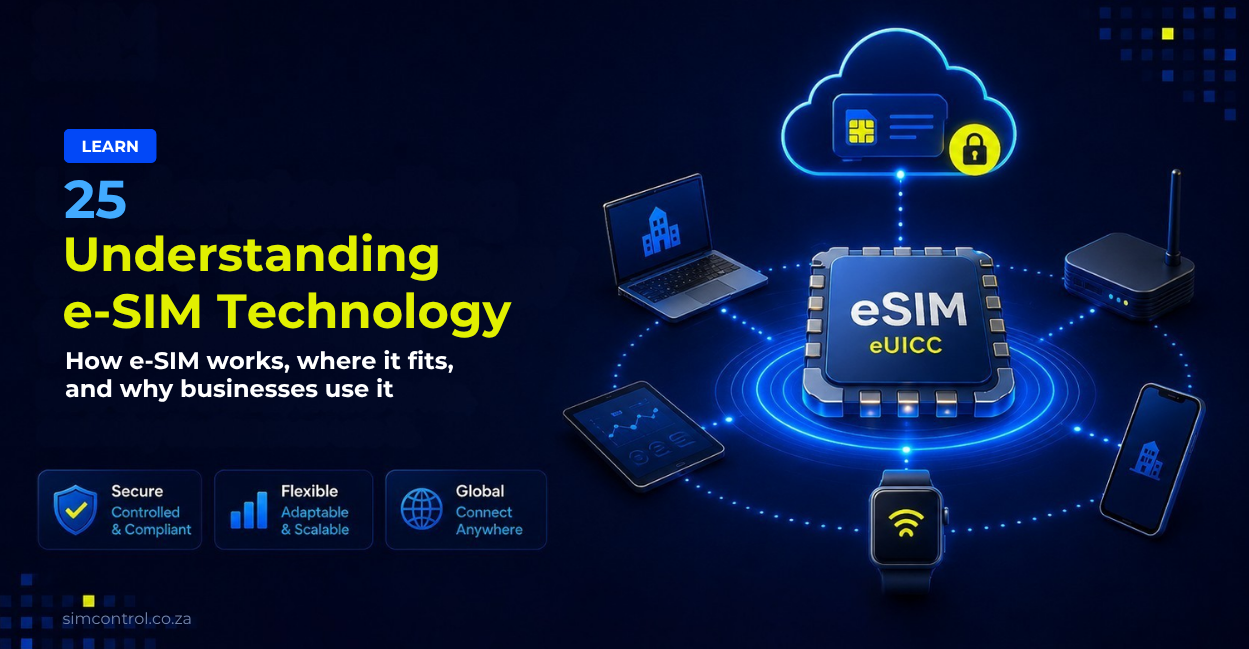
An eSIM is a digital SIM capability built into a device through an embedded secure element, known as an eUICC. Instead of inserting or replacing a physical SIM card, a mobile network profile can be downloaded and managed digitally.
For businesses, eSIM can simplify deployments, reduce physical SIM handling and make it easier to manage connectivity across devices, regions and networks.
However, eSIM is not automatically the best option for every business or IoT deployment. The right choice depends on your device type, network support, use-case, country footprint and management requirements.
What is eSIM?
eSIM stands for embedded SIM.
In simple terms, it allows a device to connect to a mobile network without relying on a removable plastic SIM card.
Instead of placing a SIM into the device, a network profile is downloaded onto the device’s eUICC. This profile contains the credentials needed to authenticate on a mobile network.
For businesses, this can make SIM provisioning more flexible, especially when devices are hard to access, deployed at scale or used across multiple regions.
Why businesses are looking at eSIM
Business customers are exploring eSIM because they want connectivity that is easier to deploy, easier to change and easier to manage.
Common drivers include:
- reducing physical SIM handling
- simplifying device manufacturing and logistics
- enabling remote profile changes
- supporting multi-country deployments
- reducing operational admin
- improving lifecycle management
- preparing for future IoT and embedded device models
For companies managing connected devices, eSIM is part of a broader shift toward more flexible connectivity management.
eSIM vs physical SIM
Physical SIM
A physical SIM is removable and inserted into a device.
Best for:
- simple deployments
- legacy devices
- quick testing
- devices where SIM swapping is practical
Limitations:
- physical handling required
- can be removed, lost or swapped
- harder to change profiles remotely
- logistics become complex at scale
eSIM
An eSIM profile is downloaded digitally onto the device’s eUICC.
Best for:
- devices where physical access is difficult
- enterprise mobility
- IoT deployments with long device lifecycles
- multi-country or multi-network planning
- devices designed without accessible SIM slots
Limitations:
- requires compatible hardware
- depends on network and platform support
- can introduce new provisioning processes
- not all markets support the same eSIM capabilities
Where eSIM makes sense for business
eSIM can be useful for:
- enterprise mobile devices
- field worker devices
- tablets and hand-held terminals
- IoT gateways
- smart meters
- telematics devices
- remote sensors
- cross-border deployments
- devices manufactured for multiple markets
The biggest benefit is flexibility.
Instead of deciding everything at the point of manufacture or installation, eSIM can allow connectivity decisions to be managed more dynamically.
Important considerations before choosing eSIM
Before moving to eSIM, businesses should confirm:
- Does the device support eSIM/eUICC?
- Which eSIM standard does the device support?
- Do the required mobile networks support the correct eSIM profile model?
- Is the deployment local or cross-border?
- Will devices need profile changes in the field?
- Is the use-case consumer-like, enterprise, or IoT/M2M?
- Who will manage provisioning, support and lifecycle changes?
eSIM is powerful, but only when the device, network and management model are aligned.
Common mistakes
- Assuming all eSIMs work the same way
- Confusing consumer eSIM with IoT eSIM
- Choosing eSIM before confirming device compatibility
- Underestimating mobile network readiness
- Forgetting about operational support and lifecycle management
- Treating eSIM as a replacement for good SIM management
FAQ
What is an eSIM?
An eSIM is a digital SIM capability built into a device. It allows a mobile network profile to be downloaded instead of using a removable physical SIM card.
Is eSIM better than a physical SIM?
Not always. eSIM is more flexible in some deployments, but physical SIMs are still practical and cost-effective for many business and IoT use-cases.
Can eSIM be used for IoT?
Yes, but the right eSIM approach depends on the device, use-case and supported eSIM standard. Consumer-style eSIM and IoT eSIM are not always the same.
Does eSIM remove the need for SIM management?
No. Businesses still need visibility, controls, reporting, support and lifecycle management across their SIM estate.
Does SIMcontrol support eSIM?
SIMcontrol supports eSIM functionality on supported local networks, as well as IoT roaming and SIM management options depending on the use-case.
Related reading
- /learn/iot-sim-card-south-africa/
- /learn/choosing-the-best-sim-type-for-iot/
- /learn/sgp32-esim-iot-cellular-deployments/
- /learn/sim-management-platform-south-africa/
Speak to SIMcontrol about IoT SIMs, Private APN, pooled data, and SIM management for your business devices.
Request a call back today