

Physical SIM, Embedded SIM, eSIM and iSIM. What is the Difference in IOT Deployments?
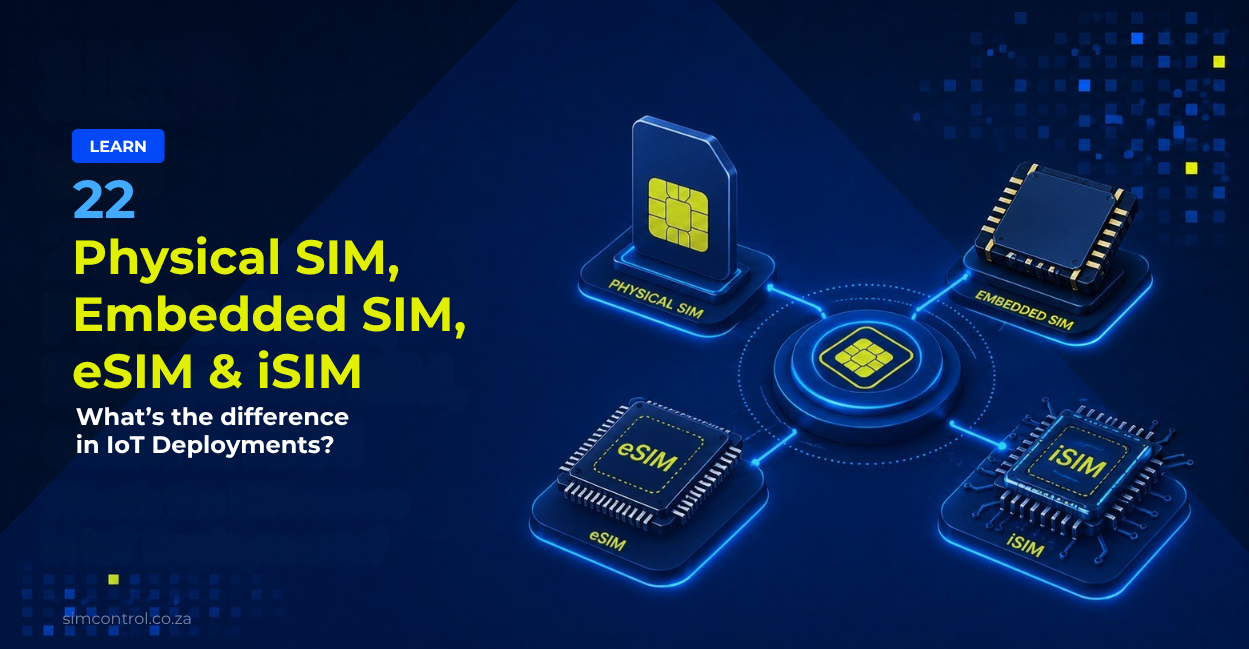
SIM types can be confusing because terms like embedded SIM, eSIM and iSIM are often used interchangeably.
In reality, they are different SIM technologies with different levels of flexibility, durability and suitability for connected devices.
For IoT deployments, choosing the right SIM format matters because it can affect:
- how the device is manufactured
- whether the SIM can be replaced easily
- how durable the device is in the field
- whether network profiles can be managed remotely
- how easy the deployment is to scale
- long-term maintenance and support costs
This guide explains the difference between the main SIM types in plain English.
Quick Answer
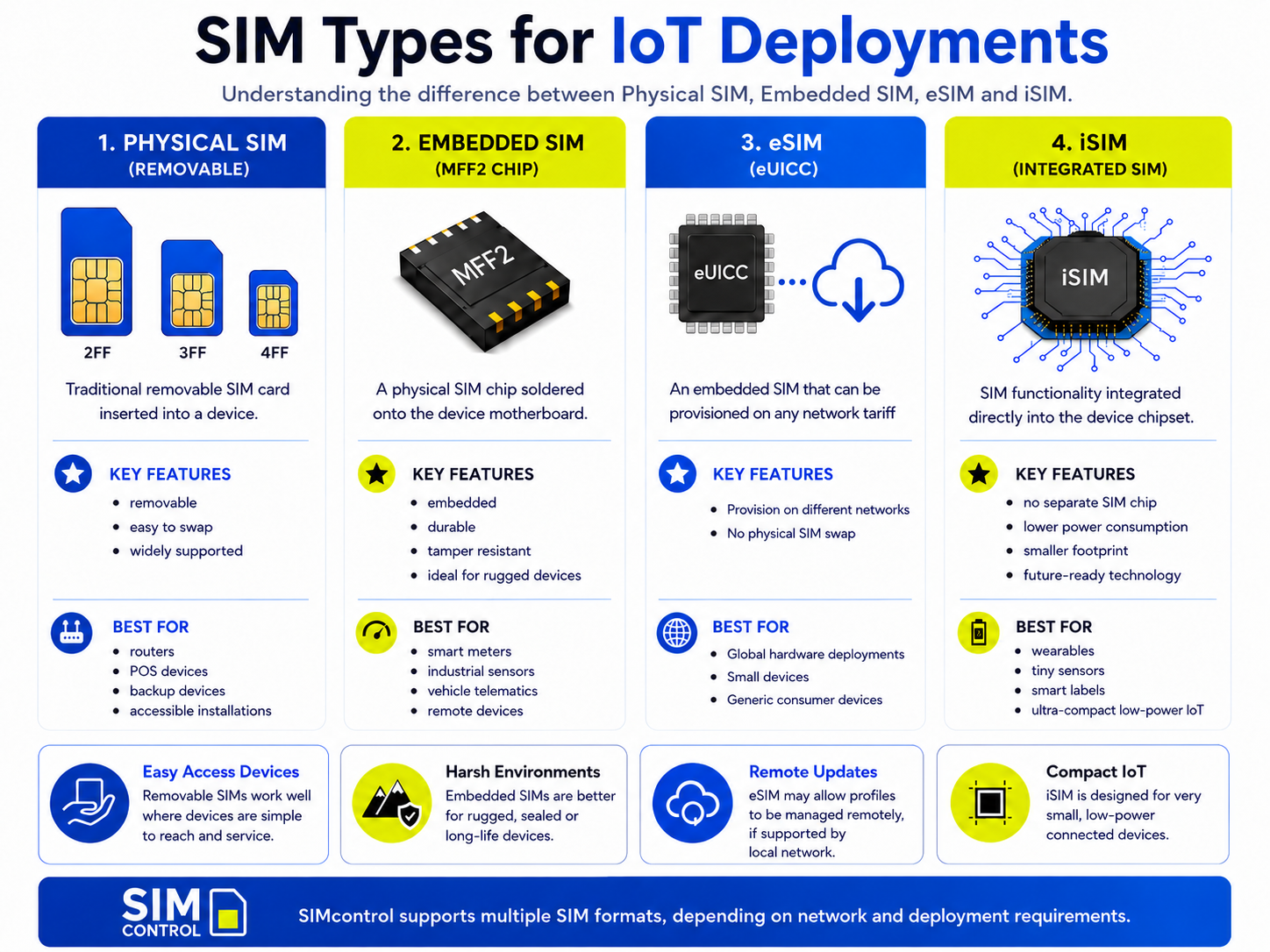
The main difference between physical SIM, embedded SIM, eSIM and iSIM is how the SIM is built into the device and how it can be managed.
A physical SIM is removable.
An embedded SIM is soldered into the device.
An eSIM supports remote provisioning and network profile management.
An iSIM is built directly into the device chipset.
Quick Comparison
Why SIM Type Matters in IoT
In consumer devices, a SIM card is often simple to access and replace.
In IoT, the situation is different.
Devices may be installed:
- inside vehicles
- on farms
- inside meters
- in security equipment
- in industrial environments
- in remote or hard-to-reach locations
- across multiple countries
Once devices are deployed, physically replacing a SIM can be expensive and disruptive. That is why SIM type matters.
The right SIM format should match the device, environment and long-term management needs of the deployment.
1. What is a Physical SIM?
A physical SIM is the traditional removable SIM card that is inserted into a device.
Common physical SIM formats include:
- 2FF – standard SIM
- 3FF – micro SIM
- 4FF – nano SIM
These SIMs are commonly supplied as 3-in-1 SIM cards, allowing the correct size to be selected for the device.
Key Features
Physical SIMs are:
- removable
- easy to swap
- widely supported
- simple to install
- practical for accessible devices
Best For
Physical SIMs work well when devices are easy to access and service.
Typical use cases include:
- routers
- POS devices
- backup devices
- tracking devices
- temporary installations
- devices installed in accessible locations
Practical Consideration
If the device is easy to reach, a physical SIM can be a practical and cost-effective choice.
If the device is sealed, remote, exposed to harsh conditions or deployed at scale, physical SIM swaps can become costly and difficult to manage.
2. What is an Embedded SIM?
An embedded SIM usually refers to a physical SIM chip that is soldered directly onto the device motherboard.
It is commonly known as:
- MFF2 SIM
- embedded SIM chip
- soldered SIM
Unlike a removable SIM card, an embedded SIM is built into the device hardware and cannot be removed easily.
Key Features
Embedded SIMs are:
- soldered into the device
- more durable than removable SIM cards
- harder to tamper with
- better suited to rugged environments
- useful for long-life devices
Best For
Embedded SIMs are often used in devices that need to operate reliably over long periods, especially in environments where movement, moisture, dust, vibration or temperature changes may be a concern.
Typical use cases include:
- smart meters
- industrial sensors
- vehicle telematics
- agriculture IoT devices
- remote monitoring devices
- equipment installed in harsh or sealed environments
Practical Consideration
Embedded SIMs are useful when the priority is durability and reduced physical handling.
However, an embedded SIM is not automatically the same as an eSIM. This distinction is important.
Embedded SIM vs eSIM: Important Clarification
Many people use the term eSIM when they actually mean embedded SIM.
They are not always the same thing.
An embedded SIM usually describes the physical format — the SIM chip is soldered into the device.
An eSIM describes remote provisioning capability — the ability to remotely download and manage network profiles.
In simple terms:
Term
What It Means
MFF2
The physical embedded SIM chip format
Embedded SIM
A SIM chip soldered into the device
eSIM / eUICC
SIM technology that supports remote provisioning
An embedded SIM can be:
- a fixed-profile SIM
- or an eUICC-enabled SIM that supports remote provisioning
So, while many eSIMs are embedded, not every embedded SIM is an eSIM.
3. What is eSIM?
An eSIM is a SIM technology that allows network profiles to be provisioned and managed remotely.
The key technology behind eSIM is eUICC, which enables remote SIM provisioning.
This means a device can potentially download, store or switch network profiles without physically replacing the SIM.
Key Features
eSIM can support:
- remote provisioning
- multiple operator profiles
- remote profile updates
- reduced need for physical SIM swaps
- more flexible network management
Best For
eSIM is useful when devices are deployed at scale or installed in places where physical access is difficult.
Typical use cases include:
- global IoT deployments
- asset tracking
- connected vehicles
- remote monitoring
- scalable IoT deployments
- devices deployed across regions or countries
Practical Consideration
For large deployments, the cost of sending teams into the field to replace SIM cards can be significant.
Where supported, eSIM can reduce this burden by allowing network profiles to be managed remotely.
This does not mean every deployment needs eSIM, but it can be valuable where flexibility and remote management are important.
4. What is iSIM?
An iSIM is an integrated SIM.
Instead of using a removable SIM card or a separate embedded SIM chip, iSIM functionality is built directly into the device chipset or modem.
This means there is no separate SIM hardware.
Key Features
iSIM can offer:
- no separate SIM chip
- smaller device footprint
- lower power consumption
- reduced hardware complexity
- improved suitability for compact devices
- future-ready device design
Best For
iSIM is most relevant for next-generation IoT devices where space, power usage and hardware efficiency are important.
Typical use cases include:
- wearables
- tiny sensors
- smart labels
- compact asset trackers
- low-power IoT devices
- high-volume connected devices
Practical Consideration
iSIM is not necessarily the starting point for every business deployment today, but it is an important technology for the future of IoT.
It is especially relevant where device size and battery life are critical.
Practical Guide: Which SIM Type Makes Sense?
Different deployments need different SIM formats.
Here is a practical way to think about it.
Easy Access Devices
Use physical SIMs where devices are easy to reach, install and service.
This is often suitable for:
- routers
- POS devices
- accessible tracking devices
- temporary deployments
Harsh Environments
Use embedded SIMs where devices are exposed to movement, vibration, heat, dust, moisture or long-term outdoor use.
This is often suitable for:
- industrial IoT
- agriculture IoT
- smart meters
- vehicle telematics
- remote equipment
Remote Updates
Use eSIM where remote provisioning and network profile management are important.
This is often suitable for:
- large-scale IoT
- global deployments
- remote devices
- devices where SIM swaps are expensive
Compact IoT
Use iSIM where devices need to be very small, power-efficient and highly integrated.
This is often suitable for:
- sensors
- wearables
- smart labels
- ultra-compact connected devices
Which SIM Type is Best for IoT?
There is no single best SIM type for every IoT deployment.
The best choice depends on:
- device design
- physical access to the device
- deployment environment
- network requirements
- country or regional coverage
- expected device lifespan
- remote management needs
- cost and operational complexity
For example, a POS terminal in a retail store may work well with a removable SIM.
A sealed smart meter may be better suited to an embedded SIM.
A global asset tracking deployment may benefit from eSIM or roaming SIM options.
A tiny low-power sensor may eventually be better suited to iSIM.
How SIMcontrol Fits In
SIMcontrol helps businesses manage any SIM types across multiple mobile network operators from one platform.
Depending on the deployment and network requirements, SIMcontrol can support management across different SIM formats and SIM environments, including:
- physical SIMs
- embedded SIM deployments
- eSIM-capable deployments
- IoT roaming SIM environments
- prepaid SIMs
- contract SIMs
- Private APN SIMs
This gives businesses more flexibility when managing connected devices, without forcing one single SIM or network strategy.
Businesses can bring existing SIMs onto the platform or order new SIMs through SIMcontrol for new deployments and scaling.
Final Takeaway
The main difference between SIM types comes down to physical format and remote management capability.
A physical SIM is removable and easy to replace.
An embedded SIM is soldered into the device for better durability.
An eSIM allows network profiles to be managed remotely, where supported.
An iSIM integrates SIM functionality directly into the chipset.
For IoT deployments, the right choice depends on the device, the environment and how the SIM needs to be managed over time.
Frequently Asked Questions
What is the difference between embedded SIM and eSIM?
An embedded SIM usually refers to a SIM chip soldered into a device, while eSIM refers to remote provisioning capability. Some embedded SIMs are eSIM-enabled, but not all embedded SIMs support remote provisioning.
Is MFF2 the same as eSIM?
No. MFF2 is a physical embedded SIM form factor. eSIM refers to the ability to remotely provision and manage SIM profiles. An MFF2 SIM can be standard or eUICC-enabled.
What does eUICC mean?
eUICC stands for embedded Universal Integrated Circuit Card. It is the technology that enables remote SIM provisioning and remote network profile management.
Is iSIM better than eSIM?
iSIM is more integrated than eSIM because the SIM functionality is built directly into the chipset. It can reduce device size and power usage, but suitability depends on the device design and deployment requirements.
Which SIM type is best for IoT?
The best SIM type depends on the deployment. Physical SIMs are useful for accessible devices, embedded SIMs are better for rugged devices, eSIM is useful for remote provisioning, and iSIM is suited to compact, low-power next-generation IoT devices.
Can SIMcontrol manage different SIM formats?
SIMcontrol can help businesses manage SIMs across different networks and deployment environments, including physical SIMs, embedded SIMs, eSIM-capable deployments and IoT roaming SIMs, depending on the network and product setup.
Slug: /learn/esim-embedded-sim-isim-iot
Speak to SIMcontrol about IoT SIMs, Private APN, pooled data, and SIM management for your business devices.
Request a call back today