

One API for Multi-Network SIM Management: How to Simplify Mobile Connectivity at Scale
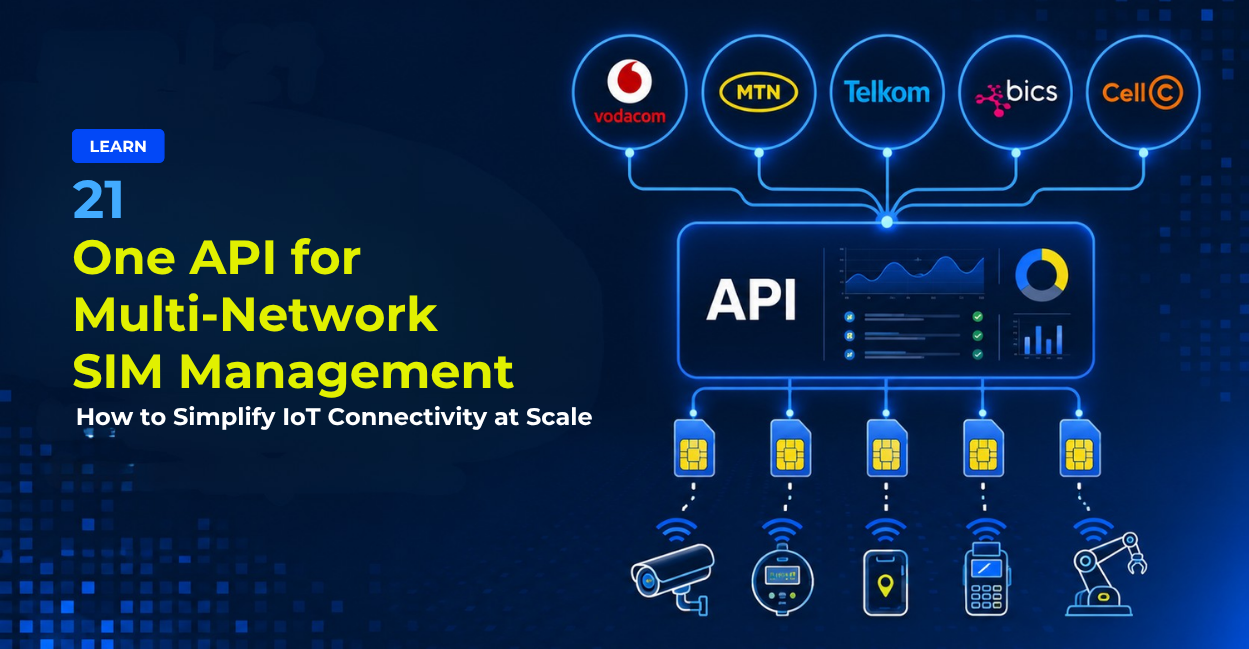
Quick answer
For modern businesses managing connected devices - from IoT fleets and smart meters to fintech POS terminals, reliable cellular connectivity is non-negotiable. However, relying on a single mobile network provider creates a critical risk of network downtime or coverage dead zones.
To guarantee uptime, businesses often need to deploy SIM cards across multiple network operators. The challenge is that managing these diverse networks through separate, fragmented and ageing operator portals can create major administrative bottlenecks, conflicting billing cycles and complex integration costs.
A unified, network-agnostic SIM management platform solves this by giving businesses one place to manage SIMs across multiple mobile networks.
Why businesses need multi-network SIM management
Businesses that rely on connected devices need cellular connectivity that is reliable, scalable and easy to manage.
This becomes more complex when devices are deployed across different locations, industries or environments. A single network may work well in one area, but perform poorly in another. For use-cases such as POS terminals, smart meters, alarms, trackers and remote IoT devices, coverage gaps can directly affect operations.
To reduce this risk, businesses often need access to multiple mobile networks such as Vodacom, MTN, Telkom and Cell C.
But multi-network access alone is not enough. Without a unified management layer, each network usually comes with its own portal, billing process, support route and API structure. This creates unnecessary complexity for technical, finance and operations teams.
The problem with fragmented operator portals
Managing SIMs across different mobile network operators can quickly become difficult when each network is managed separately.
Common challenges include:
- Separate operator portals
- Different billing cycles
- Different recharge and reporting processes
- Separate support channels
- Different API integrations
- Manual SIM activation and suspension workflows
- Limited consolidated visibility across the full SIM estate
For businesses managing large SIM estates, these challenges slow teams down and make it harder to control costs, troubleshoot issues and scale deployments.
The advantage of one network-agnostic platform
This is where a unified, network-agnostic platform transforms corporate operations.
Consolidating mobile SIM fleet management across mobile networks such as Vodacom, MTN, Telkom and Cell C into a single API provides a major strategic advantage: multi-network coverage with zero architectural fragmentation.
Instead of dedicating engineering resources to build and maintain separate API integrations for every individual carrier, developers integrate just once.
One provider for 1st-line technical support further simplifies bulk SIM management.
This single point of control allows companies to switch networks seamlessly, negotiate centralised billing and scale deployments without rewriting code.
What the SIMcontrol API enables
Together with a multi-network SIM management platform modern companies also need API access to network functions, to enable integration with their custom software and workflows. The specifications of the SIMcontrol API highlights how seamlessly multi-carrier connectivity can be put on autopilot.
1) Automated lifecycle management
Programmatically spin up or temporarily pause connections.
Business applications can trigger instant activations or suspensions based on live field requirements across any carrier.
Example API functions include:
/api/sims-activate/api/sims-suspend
This helps businesses manage SIMs dynamically instead of relying on manual processes or separate operator portals.
2) Dynamic cost control
Businesses can query available data or voice products and automate single or bulk recharges across different networks through a unified endpoint.
Example API function:
/api/recharge
Businesses can also reduce bill shock by attaching SIMs to automated, schedule-based or quota-driven rules.
Example API function:
/api/rules/sims
This is especially useful for Private APN IoT fleets, POS deployments, remote sites and high-volume SIM estates where usage can vary across devices and locations.
3) Enterprise security and remote fixes
SIMcontrol helps guard against device theft or SIM-swap fraud with remote IMEI locking and unlocking.
Example API function:
/api/sims/imei-lock
If a remote device drops offline, developers can also trigger an immediate session connection reset for Private APN SIMs.
Example API function:
/api/sims/reset-connection
This can help reduce the need for physical SIM trouble-shooting or callouts, especially when devices are deployed in the field or across hard-to-reach locations.
4) Unified data visibility
SIMcontrol makes it easier to streamline financial reporting by pulling daily itemised usage breakdowns or totals for active SIMs across all mobile networks via a single, standardised JSON payload.
Example API function:
/api/usage-details
This gives teams a consolidated view of SIM usage across networks, instead of manually pulling reports from multiple operator systems.
Why this matters for IoT and connected device businesses
For IoT and connected device deployments, the real value is not just network access. It is the ability to manage connectivity in a way that is scalable, visible and operationally efficient across networks.
A unified API helps businesses:
- Reduce integration complexity
- Manage multiple mobile networks in one place
- Improve visibility across the full SIM estate
- Automate activations, suspensions and recharges
- Improve cost control
- Reduce support complexity
- Respond faster when devices go offline
- Reduce dependency on individual operator portals
Backed by built-in enterprise architecture safeguards and geographically redundant infrastructure, SIMcontrol eliminates the traditional complexities of telecom management and integration with Mobile Network Operators.
By abstracting multiple carrier networks into a single API, your business can eliminate vendor lock-in, streamline operations and focus entirely on scaling.
Common mistakes when managing multi-network SIM estates
- Building separate API integrations for every mobile network
- Managing SIM activations and suspensions manually
- Relying on multiple operator portals for reporting
- Not having a consolidated view of SIM usage
- Waiting for month-end billing to identify over-spend or problems
- Using technical teams to maintain telecom integrations instead of focusing on core product development
FAQs
Why use one API for multiple mobile networks?
One API reduces integration complexity. Instead of building and maintaining separate integrations for each mobile network operator, developers can integrate once and manage SIMs across multiple networks from a single platform.
Is this useful for IoT deployments?
Yes. IoT deployments often need multi-network coverage, cost control, remote troubleshooting and usage visibility. A unified SIM management API helps automate and simplify these requirements.
Can a unified SIM management API help reduce bill shock?
Yes. Automated rules, usage reporting, quota controls and recharge automation can help businesses manage usage before it becomes a cost problem.
Can SIMcontrol help if a remote device goes offline?
For APN SIMs, developers can trigger a session connection reset through the SIMcontrol API. This can help resolve some connectivity issues remotely and reduce the need for physical callouts.
Does this replace mobile network operator portals?
It reduces reliance on multiple operator portals by giving businesses one platform and one API to manage SIMs across supported mobile networks.
Next steps
Book a demo → See how SIMcontrol helps businesses manage SIMs across multiple mobile networks through one platform and one API.
Contact us → Need help understanding how SIMcontrol can support your current SIM estate or API requirements? Speak to our team.
Related reading
/learn/sim-management-platform-south-africa//learn/iot-sim-card-south-africa//learn/private-apn-south-africa//learn/how-to-see-what-my-sim-cards-use-data-on/
Speak to SIMcontrol about IoT SIMs, Private APN, pooled data, and SIM management for your business devices.
Request a call back today