

Quick answer
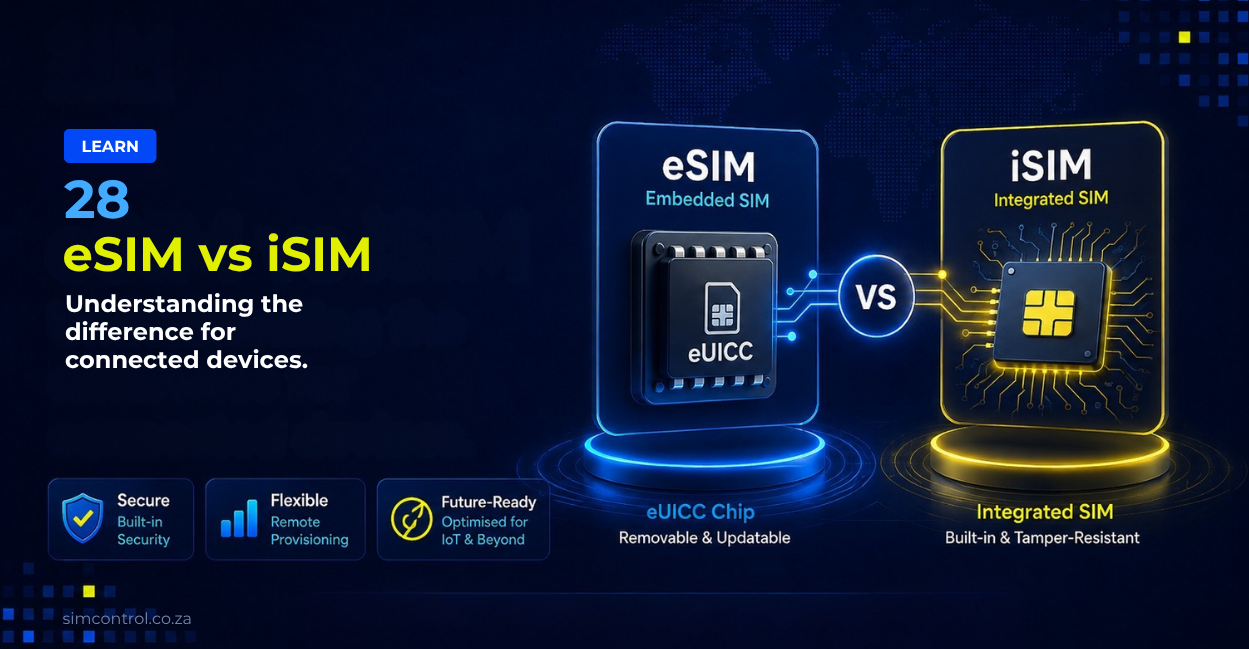
The main difference between eSIM and iSIM is where the SIM functionality sits inside the device.
An eSIM uses a dedicated embedded chip called an eUICC to store and manage mobile network profiles.
An iSIM integrates SIM functionality into the device’s main chipset or secure processor.
For IoT deployments, eSIM is generally more established today, while iSIM is an emerging option that may become more attractive for very small, low-power and high-volume devices.
eSIM vs iSIM at a glance
eSIM
- Uses a dedicated embedded eUICC chip
- Can support remote profile provisioning
- More established in devices and networks
- Common in smartphones, tablets and some IoT devices
- Still requires compatible hardware and network support
iSIM
- Integrated into the main chipset or secure processor
- Reduces separate hardware components
- Can support smaller device designs
- Potentially useful for low-power IoT
- Still emerging in commercial deployments
Why this matters for IoT
IoT devices are often deployed at scale, in remote locations and with long operating lifecycles.
The SIM type affects:
- device design
- power consumption
- manufacturing
- network provisioning
- support model
- physical security
- long-term flexibility
- roaming and multi-network options
Choosing between eSIM and iSIM is therefore not only a technical decision. It is also a commercial and operational decision.
When eSIM makes sense
eSIM is useful when:
- your device already supports eUICC
- you need remote profile management
- you want to avoid removable SIM handling
- you are deploying across multiple networks or countries
- network support is available
- you need a more established ecosystem
For many businesses, eSIM is the more practical near-term option.
When iSIM makes sense
iSIM becomes more attractive when:
- you are designing new hardware
- device size is highly constrained
- battery life is a key priority
- manufacturing efficiency matters
- the chipset ecosystem supports iSIM
- the deployment is high-volume and long-term
iSIM is likely to matter more in future IoT device design than in many current retrofit deployments.
Key considerations before choosing
Before choosing eSIM or iSIM, confirm:
- device compatibility
- supported mobile networks
- provisioning model
- country availability
- security requirements
- power constraints
- hardware lifecycle
- support model
- total cost of ownership
The best SIM type is the one that matches the device and business requirement, not necessarily the newest technology.
Common mistakes
- Assuming iSIM is simply “better eSIM”
- Choosing based on hardware trends instead of deployment reality
- Ignoring mobile network support
- Underestimating provisioning complexity
- Forgetting about long-term support and migration
FAQ
Is iSIM replacing eSIM?
Not immediately. iSIM may grow in importance, but eSIM remains more established in many current business and IoT deployments.
Is iSIM smaller than eSIM?
Yes. iSIM can reduce hardware components because SIM functionality is integrated into the main chipset.
Which is better for IoT: eSIM or iSIM?
It depends on your device and rollout. eSIM is often more practical today. iSIM may be better for future high-volume, small or low-power devices.
Can both eSIM and iSIM support remote provisioning?
They can, depending on hardware, standards support and the provisioning ecosystem.
Should I choose eSIM or iSIM for a current rollout?
For current deployments, first check what your device supports and what your target networks can support. In many cases, eSIM or physical SIM options may still be the safer choice.
Related reading
- /learn/what-is-an-isim/
- /learn/understanding-esim-technology-for-business/
- /learn/embedded-sim-explained/
- /learn/choosing-the-best-sim-type-for-iot/
Speak to SIMcontrol about IoT SIMs, Private APN, pooled data, and SIM management for your business devices.
Request a call back today