

Quick answer
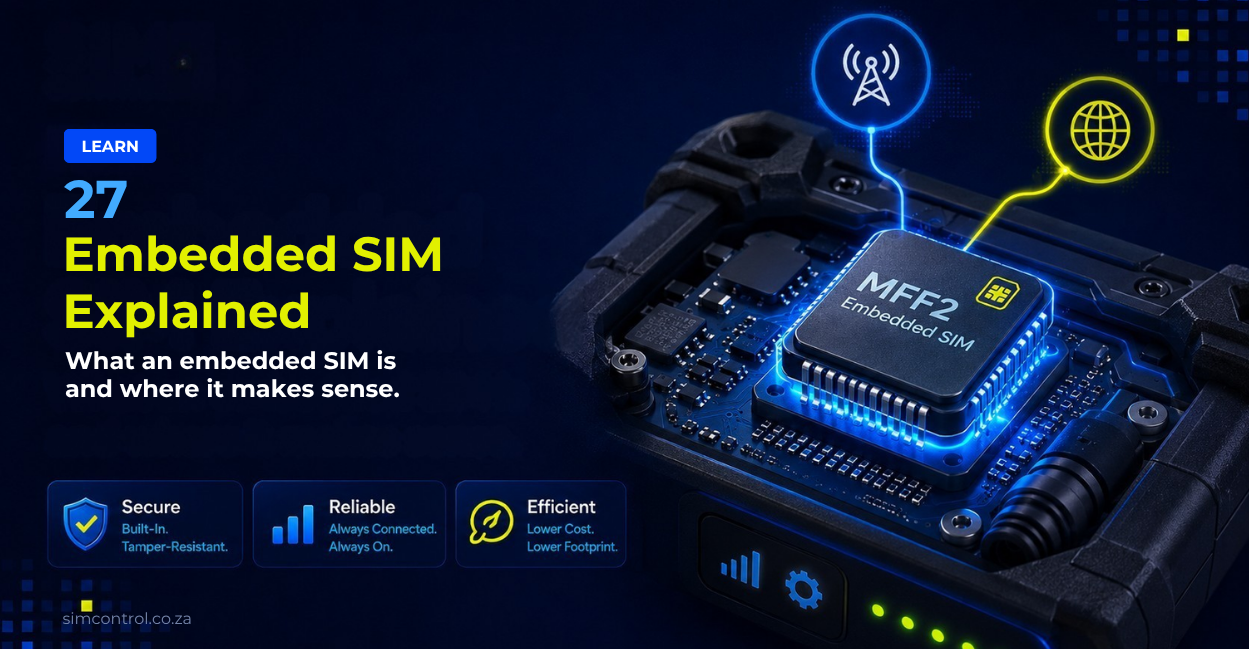
An embedded SIM is a SIM component that is built into a device rather than inserted as a removable plastic SIM card.
In IoT, embedded SIMs are often used where devices need to be more durable, tamper-resistant or difficult to physically access.
The term “embedded SIM” can sometimes be used loosely, so it is important to understand whether someone means a soldered SIM, an eUICC/eSIM, or an integrated SIM approach.
What is an embedded SIM?
An embedded SIM is a SIM that forms part of the device hardware.
Unlike a removable SIM card, it is not designed to be physically swapped by a user.
In IoT and M2M devices, embedded SIMs are used to improve reliability and reduce physical handling.
Depending on the device design, an embedded SIM may be:
- a soldered SIM component
- an eUICC that supports eSIM profiles
- part of a broader embedded connectivity module
This is why businesses should always clarify the exact SIM type when discussing “embedded SIM”.
Why embedded SIMs are used in IoT
IoT devices are often installed in locations where physical SIM access is difficult or risky.
Examples include:
- smart meters
- alarm panels
- industrial sensors
- vehicle tracking devices
- remote telemetry devices
- sealed hardware
- outdoor devices
- devices deployed at customer sites
In these environments, embedded SIMs can reduce operational complexity and improve physical resilience.
Benefits of embedded SIMs
1) Better device durability
Because the SIM is built into the device, there is no SIM tray to open, damage or expose to dust, water or tampering.
2) Reduced SIM swapping risk
An embedded SIM is harder to remove or misuse.
This can be useful where SIM theft, SIM swapping or device tampering is a concern.
3) Better for sealed devices
Many IoT devices are designed to be sealed for environmental protection.
Embedded SIMs support this design better than removable SIM cards.
4) Less field maintenance
If the SIM is not intended to be physically changed, support teams are less likely to need site visits for SIM replacement or reseating.
Embedded SIM vs eSIM
The terms are often used interchangeably, but they do not always mean the same thing.
An embedded SIM describes the physical form factor: the SIM is built into the device.
An eSIM usually refers to the ability to remotely download or manage mobile network profiles on an eUICC.
So an embedded SIM may or may not support remote eSIM profile management.
This distinction matters for business and IoT deployments.
When embedded SIMs make sense
Embedded SIMs are useful when:
- devices are difficult to access physically
- devices are sealed or ruggedised
- tamper resistance matters
- long lifecycle deployments are expected
- installation teams need fewer physical SIM handling steps
- device reliability is more important than easy SIM swapping
They are especially relevant for managed IoT fleets where devices remain in the field for years.
When a removable SIM may still be better
A removable SIM may still be practical when:
- you are testing or piloting
- devices need quick SIM swaps
- network strategy is still changing
- hardware is low-cost or short lifecycle
- field teams need flexibility
- device compatibility is uncertain
For many businesses, the right answer is a mix of SIM types depending on the deployment stage.
Common mistakes
- Assuming embedded SIM always means eSIM
- Choosing embedded SIM without confirming profile management capability
- Ignoring network and platform support
- Using embedded SIMs for pilots where flexibility is still needed
- Not planning lifecycle support before deployment
FAQ
Is an embedded SIM the same as an eSIM?
Not always. An embedded SIM means the SIM is built into the device. An eSIM usually refers to remote profile management capability on an eUICC.
Can an embedded SIM be removed?
Typically no. Embedded SIMs are designed to be built into the device and not physically swapped like a standard SIM card.
Is embedded SIM good for IoT?
Yes. Embedded SIMs can be useful for rugged, sealed, long-life or tamper-resistant IoT devices.
Does embedded SIM support remote provisioning?
Only if the embedded SIM is an eUICC and the broader ecosystem supports remote provisioning.
Should I use embedded SIM or physical SIM?
It depends on your device, lifecycle, support model and need for flexibility. Physical SIMs are useful for testing and flexibility. Embedded SIMs are useful for durability and long-term deployments.
Next step
Primary CTA: Contact SIMcontrol
Planning an IoT device rollout and unsure which SIM type is best? Contact SIMcontrol to discuss physical SIM, embedded SIM, eSIM and IoT roaming options.
Secondary CTA: Start a free trial
Test SIM options and connectivity behaviour before scaling.
Related reading
- /learn/understanding-esim-technology-for-business/
- /learn/what-is-an-isim/
- /learn/esim-vs-isim/
- /learn/choosing-the-best-sim-type-for-iot/
Speak to SIMcontrol about IoT SIMs, Private APN, pooled data, and SIM management for your business devices.
Request a call back today