

What is the Difference Between an IoT SIM and a Normal Data SIM?
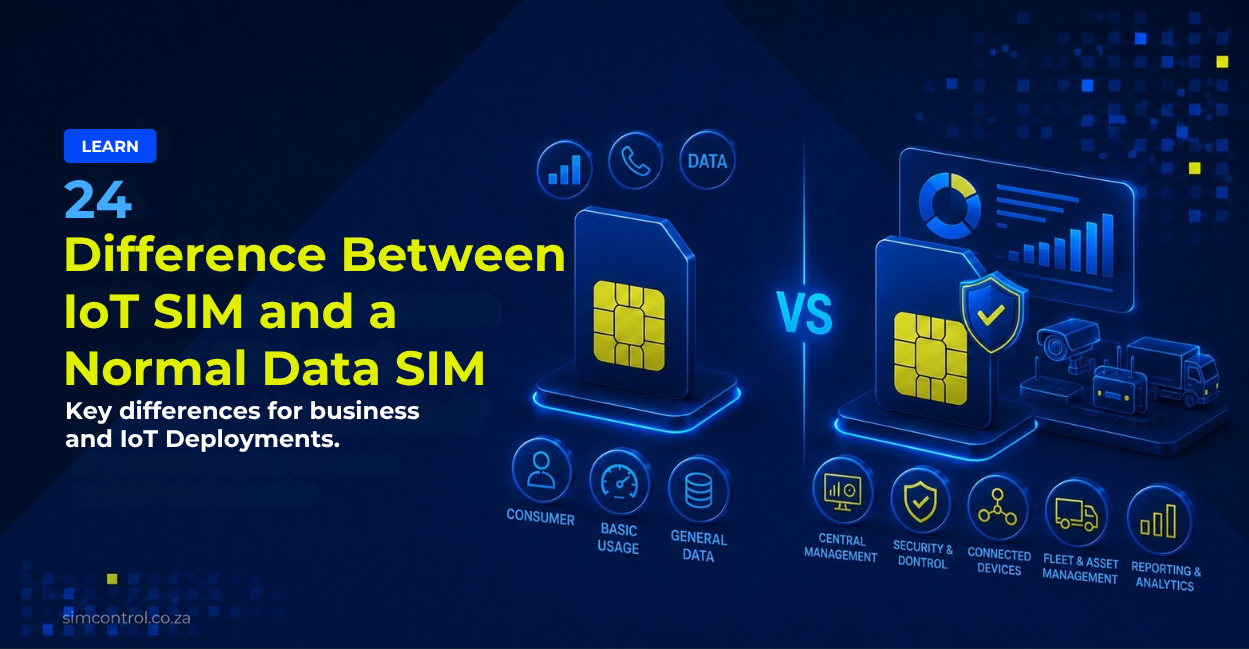
When deploying connected devices — whether it is a fleet of delivery vehicles, security cameras, POS terminals, smart meters or remote monitoring devices — it may seem easier to use a standard post-billed data SIM.
After all, if it connects to the internet, it should work. Right?
Technically, a normal data SIM can work ok in some connected devices. But for business-critical, industrial or large-scale IoT deployments, normal data SIMs often create operational challenges.
IoT SIMs are designed for machines, not people. They are built to support remote devices, usage control, network resilience, better visibility and long-term management at scale.
Quick Answer
The main difference between an IoT SIM and a normal data SIM is that a normal data SIM is designed for consumer use on the open "public" internet, while an IoT SIM is designed for connected devices that need to be monitored, controlled and managed on data session level and at scale, with hundreds or thousands of SIMs deployed.
An IoT SIM is typically used in field devices such as trackers, cameras, meters, sensors, payment devices, alarms, tablets, rugged hand-helds and industrial equipment.
Normal Data SIM vs IoT SIM: Quick Comparison
Why Normal Data SIMs Can Become a Problem in IoT Deployments
A normal data SIM is often designed around human behaviour.
For example, a person using a smartphone can notice when something is wrong. They can move to another area, restart the phone, check their balance, change settings or contact support.
IoT devices do not behave like that.
A connected device may be:
- installed remotely
- sealed inside hardware
- mounted on a vehicle
- deployed on a farm
- used in a security system
- deployed across hundreds or thousands of locations
- expected to run without human intervention
If something goes wrong, the device can go offline silently. Or data usage can spike without anyone noticing. A SIM can be moved into the wrong device. There can be issues on the server destinations the device is trying to reach/ There is no trouble-shooting info. A bill can increase before the business has time to react.
This is why IoT SIMs need proper management, controls and visibility.
Why IoT SIMs Matter for Machine-to-Machine Operations
IoT SIMs are used in machine-to-machine environments where devices need to send and receive data reliably over time.
These devices often do not need massive data bundles. Instead, they need:
- reliable connectivity
- predictable usage
- centralised control
- alerts when something changes
- visibility across all SIMs
- the ability to scale without manual admin
- stronger cost management
This becomes especially important when a business is managing hundreds or thousands of SIMs across multiple networks.
1. Network Resilience and Multi-Network Options
If a mobile phone loses signal, the person using it can usually move location or wait for the signal to return.
If a remote pump, tracking device, security panel or smart meter loses signal, the device may simply stop reporting.
For IoT deployments, network resilience matters.
Depending on the deployment and SIM type, IoT SIMs may support:
- local network connectivity
- shared pooled data between multiple networks
- roaming options
- multi-network roaming
- private APN configurations
- managed failover options
- more controlled network access & data session level insight
- IoT-grade technical support
This helps businesses choose the right network approach for each use case, instead of relying on one standard consumer-style SIM setup.
2. Better Data Control and Pooling
Normal data plans are often designed around individual users and fixed monthly bundles.
IoT devices often behave differently. Some devices may use very little data. Others may spike unexpectedly if there is a fault, configuration issue or device behaviour change.
For businesses, the risk is not just data usage. It is unmanaged data usage.
IoT SIM management can help by enabling:
- pooled data
- usage thresholds
- automated alerts
- rules and controls
- SIM-level visibility
- better data allocation across devices
This helps businesses reduce wasted spend and avoid unexpected out-of-bundle costs.
3. Centralised SIM Management
Managing one or two SIMs manually is possible.
Managing hundreds or thousands of SIMs manually becomes difficult very quickly.
A business may need to know:
- which SIM is active
- which device it is in
- how much data it is using
- which network it is on
- whether it has gone silent
- whether it has exceeded expected usage
- whether it should be suspended, topped up or investigated
A platform like SIMcontrol gives businesses one place to manage SIMs across multiple networks and SIM types.
This is especially useful when SIMs are spread across different devices, regions, projects, branches or customer deployments.
4. Live Usage Visibility
One of the biggest risks in IoT is not knowing what is happening until after the fact.
Without proper visibility, businesses may only discover issues when:
- the bill arrives
- a device stops working
- a customer complains
- a field team investigates
- a SIM has already used too much data
IoT SIM management gives businesses a clearer view of SIM behaviour.
This can include:
- live or near-real-time usage visibility
- balance monitoring where supported
- usage reporting
- SIM activity (data session) views
- device or project grouping
- exception alerts
This helps teams identify abnormal usage, silent devices or possible faults sooner.
5. Rules, Alerts and Automation
IoT deployments need guardrails.
For example, a business may want to set rules such as:
- alert me when a SIM reaches a certain usage level
- prevent a device from using more than a defined amount of data
- allow only a certain number of top-ups per month
- flag unexpected usage spikes
- restrict a SIM to an approved device where supported
These kinds of controls are difficult to manage properly with normal consumer-style SIMs.
With a SIM management platform, rules and alerts can be applied across the SIM estate to reduce manual work and improve control.
6. Device Locking and Security Controls
In some IoT environments, a SIM may be installed in a device that is left unattended, mobile or remote.
If the SIM is removed and placed into another device, it could create security, cost or misuse risks.
Depending on the network and product setup, business SIM deployments may support controls such as:
- SIM suspension
- data blocking
- usage restrictions
- IMEI locking on selected products
- private APN access controls
- custom routing or firewalling on supported APN setups
These controls help reduce risk and support better governance across connected devices.
7. Simpler Billing and Reporting
When SIMs are spread across different networks, contracts and product types, billing can become difficult to manage.
Businesses may have prepaid SIMs, contract SIMs, Private APN SIMs and roaming SIMs across multiple providers.
Without a central management layer, teams may struggle to connect SIM costs and usage to:
- customers
- projects
- device groups
- branches
- departments
- regions
- network providers
SIMcontrol helps simplify this by giving businesses a centralised view of their SIM estate, usage and reporting across multiple networks and SIM types.
What SIM Formats Can Be Used in IoT?
IoT SIMs can come in different physical and digital formats.
The right format depends on the device design, deployment environment and network requirements.
Physical SIM vs Embedded SIM vs eSIM vs iSIM
A normal consumer SIM is often a removable physical SIM.
IoT deployments may require a broader range of SIM formats.
Physical SIM
A physical SIM is removable and easy to replace. It works well where devices are easy to reach and service.
Typical use cases include:
- routers
- POS devices
- tracking devices
- backup connectivity devices
Embedded SIM / MFF2
An embedded SIM is a physical SIM chip soldered into the device motherboard.
It is better suited to rugged or sealed devices where durability matters.
Typical use cases include:
- smart meters
- industrial sensors
- vehicle telematics
- agriculture IoT
- remote monitoring devices
eSIM / eUICC
An eSIM supports remote provisioning and network profile management where supported.
It can reduce the need for physical SIM swaps and is useful in large or remote deployments. The downside is manual activation (via QR or activation code).
Typical use cases include:
- global IoT
- asset tracking
- connected vehicles
- remote device deployments
- scalable IoT rollouts
iSIM
An iSIM integrates SIM functionality directly into the chipset, with no separate SIM card or SIM chip.
It is most relevant for compact, low-power and next-generation IoT devices.
Typical use cases include:
- wearables
- smart labels
- tiny sensors
- compact asset trackers
- battery-powered IoT devices
Important Clarification: Embedded SIM is Not Always eSIM
Many people use the word eSIM when they actually mean embedded SIM.
They are not always the same thing.
An embedded SIM usually refers to the physical format — a SIM chip soldered into the device.
An eSIM refers to remote provisioning capability.
In simple terms:
An embedded SIM can be a fixed-profile SIM or an eUICC-enabled SIM. This is why businesses should confirm both the SIM format and the provisioning capability when choosing an IoT SIM.
Onboarding an IoT SIM Estate
A well-managed IoT deployment should not start with SIMs alone. It should start with a clear view of the deployment requirements.
A practical onboarding process includes:
1. Define the use case
Identify what the device needs to do, how often it sends data, where it will be deployed and how critical uptime is.
2. Choose the right SIM type
Select the right network and SIM product and format based on the device, environment, coverage needs and long-term management requirements. Choosing the best SIM tariff (public or private APN) for the device and deployment.
3. Bring existing SIMs or order new SIMs
Businesses can bring existing SIMs onto SIMcontrol where supported or order new SIMs through SIMcontrol for new deployments and scaling.
4. Group SIMs properly
Organise SIMs by customer, project, device type, region, network or operational team.
5. Set rules and alerts
Apply usage limits, top-up rules, spend controls, inactivity alerts and other operational guardrails.
6. Monitor and optimise
Track usage, identify abnormal behaviour, manage SIM status and optimise the SIM estate over time.
How SIMcontrol Helps with IoT SIM Management
SIMcontrol provides the management layer above multiple mobile network operators.
It helps businesses manage SIMs across different networks, products and deployment types from one platform.
SIMcontrol can support:
- existing SIMs already deployed in devices
- new SIMs ordered through SIMcontrol
- prepaid SIMs
- contract SIMs
- Private APN SIMs
- IoT roaming SIMs
- physical SIMs
- embedded SIM deployments
- eSIM-capable deployments, depending on network support
With SIMcontrol, businesses can improve visibility, reduce bill shock, apply rules and alerts, pool data where applicable and manage SIMs without being locked into one network strategy.
Final Takeaway
A normal data SIM may work in some connected devices, but it is not always the best choice for business-critical or scalable IoT deployments.
IoT SIMs are designed for connected machines that need better visibility, control, network resilience and long-term management.
For businesses managing SIMs across multiple devices, networks or regions, the SIM itself is only part of the solution. The real value comes from being able to manage the full SIM estate from one platform.
Frequently Asked Questions
Can I use a normal data SIM in an IoT device?
Technically, yes. A normal data SIM may work in some IoT devices. However, for business-critical or large-scale deployments, it may create challenges around cost control, visibility, roaming, device management and long-term support.
What is an IoT SIM?
An IoT SIM is a SIM used for connected devices such as trackers, meters, cameras, sensors, alarms, POS terminals and industrial equipment. It is typically selected and managed based on device requirements, data usage, coverage, resilience and control.
What is the difference between an IoT SIM and a normal data SIM?
A normal data SIM is usually designed for human use in phones, tablets or routers. An IoT SIM is designed for connected devices that may need centralised management, usage controls, roaming options, durability and long-term scalability.
What is a roaming IoT SIM?
A roaming IoT SIM is configured to connect across more than one network, depending on the roaming setup and coverage available. This can be useful for devices that move across regions or operate in areas where a single network may not provide sufficient coverage.
What SIM format is best for IoT?
The best SIM format depends on the device and deployment. Physical SIMs work well for accessible devices, embedded SIMs are useful for rugged or sealed devices, eSIM can save space on hardware, and iSIM is designed for compact, low-power devices.
Do IoT SIMs help reduce bill shock?
IoT SIMs, when managed through a platform like SIMcontrol, can help reduce bill shock by enabling usage visibility, alerts, rules, data controls and reporting across the SIM estate.
Can SIMcontrol manage existing IoT SIMs?
Yes. SIMcontrol can help businesses manage existing SIMs where supported, without requiring unnecessary SIM replacement.
Can I order IoT SIMs through SIMcontrol?
Yes. Businesses can order new SIMs through SIMcontrol for new IoT deployments, expansion or scaling.
Does SIMcontrol provide the network?
SIMcontrol is not a mobile network operator. SIMcontrol provides the SIM management platform layer that helps businesses manage SIMs across multiple mobile network operators from one interface.
How does SIMcontrol help with IoT deployments?
SIMcontrol helps businesses monitor, control and optimise SIMs used in IoT deployments. This includes visibility, usage alerts, spend controls, pooled data where applicable, SIM status management and reporting across multiple networks.
Speak to SIMcontrol about IoT SIMs, Private APN, pooled data, and SIM management for your business devices.
Request a call back today