

Quick answer
The best SIM type for IoT depends on your device, use-case, deployment size, country footprint and lifecycle requirements.
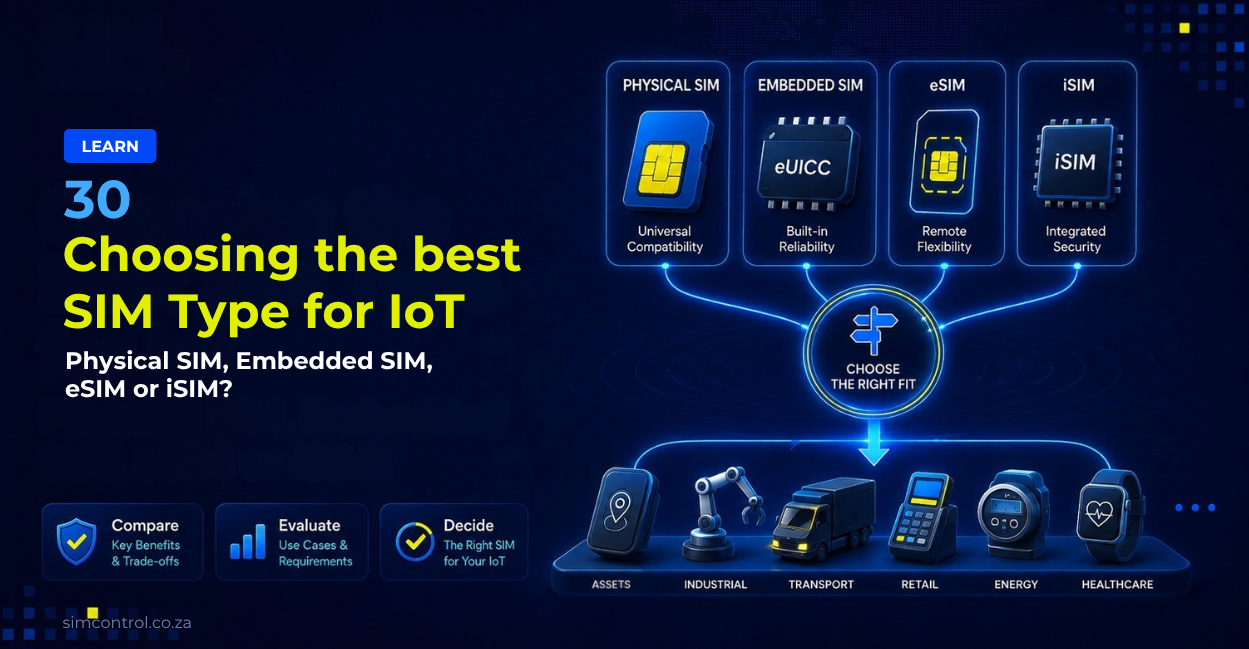
For many businesses, the choice is between:
- physical SIM
- embedded SIM
- eSIM
- iSIM
- roaming or multi-IMSI SIM
There is no single “best” SIM type for every IoT deployment. The right choice is the one that gives your devices reliable connectivity, manageable operations and the right commercial model.
Why SIM type matters in IoT
In IoT, the SIM is not just a plastic card.
It affects:
- device design
- installation process
- network access
- remote support
- security
- roaming
- cost control
- long-term flexibility
- field maintenance
Choosing the wrong SIM type can create operational problems later, especially once devices are deployed at scale.
SIM type options for IoT
1) Physical SIM
A removable SIM inserted into a device.
Best for:
- pilots
- flexible deployments
- legacy hardware
- quick swapping
- testing different networks
Limitations:
- can be removed or tampered with
- physical logistics can be difficult at scale
- not ideal for sealed devices
2) Embedded SIM
A SIM built into the device hardware.
Best for:
- rugged devices
- sealed devices
- long-life IoT deployments
- tamper-resistant use-cases
Limitations:
- less flexible if it does not support remote provisioning
- must be planned during hardware selection
3) eSIM
A digital SIM capability that allows profiles to be downloaded onto an eUICC.
Best for:
- remote provisioning
- multi-country planning
- devices where physical SIM access is difficult
- enterprise and IoT deployments where supported
Limitations:
- depends on device and network support
- consumer eSIM and IoT eSIM models differ
4) iSIM
A SIM capability integrated into the device chipset.
Best for:
- future high-volume IoT devices
- small form factor devices
- low-power designs
- hardware designed around integrated connectivity
Limitations:
- ecosystem is still emerging
- requires compatible chipset, network and provisioning support
5) Roaming or multi-IMSI SIM
A SIM that can connect across countries or networks using roaming or multiple IMSIs.
Best for:
- cross-border deployments
- logistics and freight
- devices moving between countries
- African regional IoT rollouts
Limitations:
- cost and routing must be managed carefully
- network behaviour can vary by country
- may not suit every latency or compliance requirement
Decision checklist
Choose your SIM type by asking:
- Is the device fixed or mobile?
- Is the device easy to access physically?
- Is the deployment local or cross-border?
- How long will the device stay in the field?
- Does the device need to be tamper-resistant?
- Does the device need remote profile changes?
- What network technologies does the device support?
- Is low power consumption critical?
- Do you need Private APN or secure routing?
- Do you need SIM management and usage controls?
Practical guidance
For pilots
Use physical SIMs or easy-to-manage eSIM where supported.
The priority is flexibility.
For sealed or rugged devices
Consider embedded SIM or eSIM depending on hardware support.
The priority is durability and reduced field handling.
For cross-border devices
Consider multi-IMSI or roaming options.
The priority is coverage and commercial predictability across countries.
For high-volume future devices
Consider eSIM, SGP.32 or iSIM where the ecosystem supports it.
The priority is long-term scalability and lifecycle management.
Common mistakes
- Choosing a SIM type before confirming device compatibility
- Using consumer eSIM assumptions for IoT devices
- Ignoring local network support
- Using removable SIMs in high-tamper-risk environments
- Not planning for support after devices are installed
- Assuming roaming solves every cross-border requirement
- Choosing the newest technology instead of the most deployable option
FAQ
What is the best SIM type for IoT?
There is no universal best SIM type. It depends on the device, use-case, location, power requirements and deployment model.
Are physical SIMs still useful for IoT?
Yes. Physical SIMs are still practical for pilots, testing, legacy devices and deployments where flexibility is important.
When should I use eSIM for IoT?
Use eSIM when your device, network and provisioning model support it, especially where remote profile management or reduced physical SIM handling is important.
Is iSIM ready for all IoT deployments?
No. iSIM is promising, but still emerging. It is best considered where chipset, device and network support are confirmed.
What SIM type is best for Africa-wide IoT?
For many cross-border African deployments, multi-IMSI or roaming SIMs may be practical. Local SIMs or hybrid approaches may also be needed depending on country, network and commercial requirements.
Related reading
- /learn/iot-sim-card-south-africa/
- /learn/global-iot-connectivity-explained/
- /learn/understanding-esim-technology-for-business/
- /learn/sgp32-explained/
Speak to SIMcontrol about IoT SIMs, Private APN, pooled data, and SIM management for your business devices.
Request a call back today